Quantum error correction encodes one logical qubit across 121+ physical qubits using surface codes. Google Willow achieved below-threshold error correction in 2024. QuEra holds the 2026 record with 96 logical qubits.
Quantum computing error correction is the set of engineering techniques that protect quantum information from noise, decoherence, and gate errors. Without it, every quantum calculation collapses into meaningless output before producing a useful result.
“In June 2026, Microsoft Azure Quantum announced achieving 99.9% two-qubit gate fidelity on their topological qubit platform — the closest any team has come to fault-tolerant threshold on a scalable architecture.”
Current quantum processors fail between 0.1% and 1% of all gate operations. That sounds small — but a useful quantum algorithm needs billions of operations. At 1% error per gate, the computation fails almost immediately. Quantum computing error correction (QEC) solves this by detecting and fixing errors in real time, without ever directly reading the fragile quantum state being protected.
In 2026, QEC moved from theory to engineering reality. Google’s Willow processor crossed the error correction threshold for the first time in history. QuEra demonstrated 96 verified logical qubits — the current world record. This guide explains how it all works, from the ground up.
Key Takeaways
- QEC encodes one logical qubit across many physical qubits to protect quantum information
- Three quantum error types exist: bit-flip, phase-flip, and bit-phase flip
- The surface code is the dominant QEC method used by Google, IBM, and Quantinuum
- Google Willow proved that adding more physical qubits reduces logical errors exponentially
- QuEra holds the 2026 world record at 96 verified logical qubits
- Full fault-tolerant quantum computing is still years away — but the engineering path is now confirmed
What Is Quantum Computing Error Correction? (QEC Meaning Explained)
Quantum computing error correction is a technique where groups of physical qubits work together to protect a single logical qubit. Instead of reading the quantum state directly — which would destroy it — engineers measure relationships between qubits to detect disturbances. These relationship measurements are called syndrome measurements.
The result: errors leave a detectable fingerprint without collapsing the quantum information inside.
Physical Qubit vs Logical Qubit — What Is the Difference?
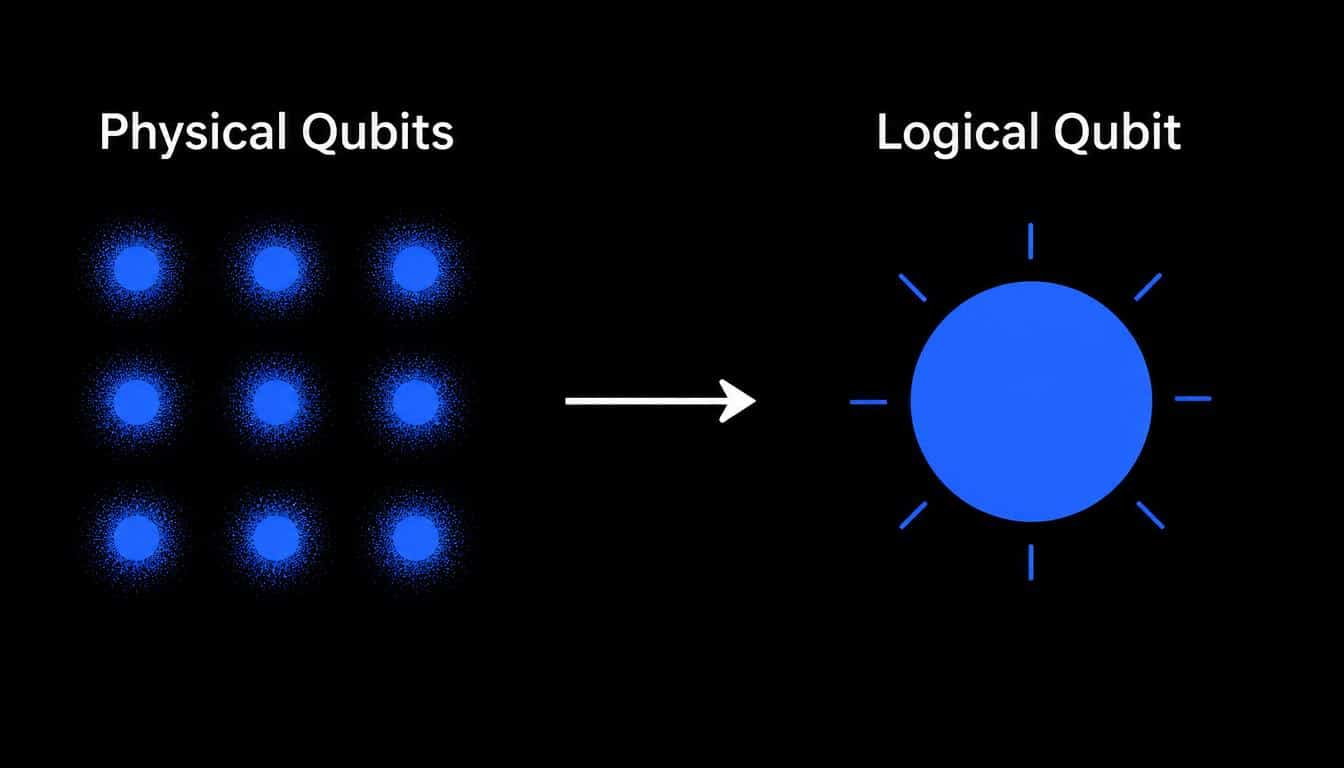
A physical qubit is the actual hardware — a superconducting circuit, trapped ion, or neutral atom. It is real, noisy, and constantly prone to errors.
A logical qubit is a protected virtual qubit built from many physical qubits working together. To the quantum algorithm running on top, it behaves like one stable, reliable qubit — even though the underlying hardware is making mistakes continuously.
The cost is overhead. One logical qubit currently requires anywhere from 10 to over 100 physical qubits depending on the error correction code and target error rate.
Why Classical Error Correction Fails on Qubits
Classical computers use repetition: store a bit three times, compare all three, take the majority vote. Simple and effective.
Quantum mechanics prevents this entirely. The no-cloning theorem states that an unknown quantum state cannot be copied. And measuring a qubit to check its value destroys the superposition you were protecting in the first place.
QEC solves this by spreading quantum information across entangled qubits in a structured pattern — one where errors show up as syndrome anomalies that can be identified and corrected without ever reading the protected data.
What Are the Three Types of Quantum Errors?
Understanding quantum error types is essential for understanding why different QEC codes exist and why one code cannot fix everything.
Bit-Flip Errors
A bit-flip error occurs when a qubit spontaneously flips from |0⟩ to |1⟩ or vice versa. This has a classical analogue — it behaves like a corrupted binary digit. Bit-flip errors are caused by environmental noise, imperfect gate pulses, or electromagnetic interference.
Detection: parity checks between neighbouring qubits reveal the inconsistency without reading any individual qubit.
Phase-Flip Errors
A phase-flip error has no classical equivalent. It does not change the probability of a qubit measuring 0 or 1 — it changes the relative phase between superposition states. The state |+⟩ becomes |−⟩, which is invisible to classical measurement but corrupts any subsequent quantum calculation that depends on interference.
According to QuEra’s glossary, phase errors result from decoherence — when gate operations take longer than a qubit can hold its phase. Phase-flip errors are more common in superconducting systems than bit-flip errors and require a different correction circuit.
Bit-Phase Flip and Decoherence
A bit-phase flip combines both errors simultaneously — the qubit state flips and the phase changes at the same time. Decoherence is the broader process underlying all three types: as a qubit interacts with its environment over time, it gradually loses all quantum properties.
This is why QEC must run continuously and in real time. Errors compound fast, and a correction applied one microsecond too late may be worthless.
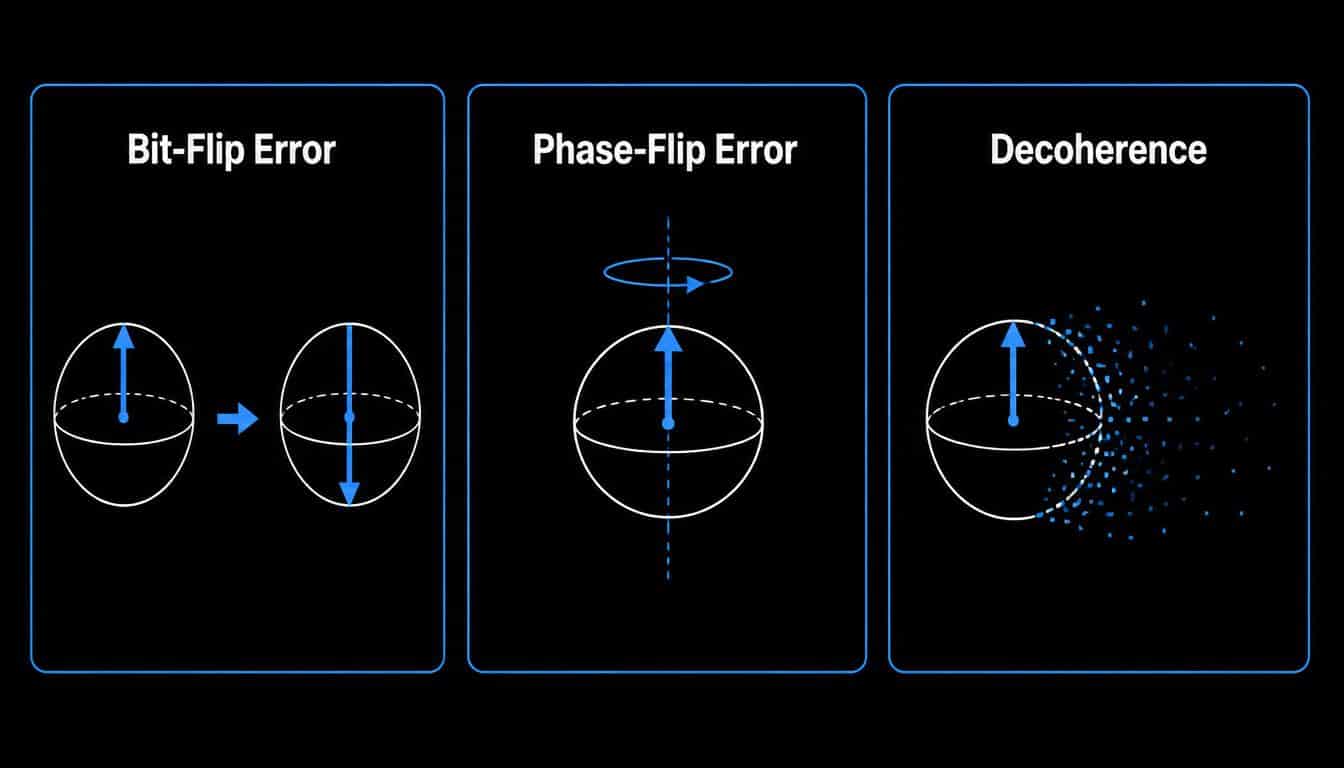
| Error Type | What Changes | Has Classical Equivalent | Correction |
|---|---|---|---|
| Bit-flip | Qubit state (0↔1) | ✅ Yes | X gate after parity check |
| Phase-flip | Relative phase of superposition | ❌ No | Z gate after Hadamard check |
| Bit-phase flip | Both state and phase | ❌ No | Y gate correction |
| Decoherence | All quantum properties decay | Partial | Fast gates + active QEC cycles |
How Does Quantum Error Correction Actually Work?
The Shor Code — Where It Started
Peter Shor introduced the first practical QEC code in 1995. The Shor code encodes one logical qubit into nine physical qubits. Three groups of three qubits each protect against bit-flip errors. A second layer across the groups protects against phase-flip errors. Together: the first code capable of correcting any single-qubit error.
The Shor code is not used in modern hardware — it is too expensive in physical qubits. But it proved the foundational concept that still drives the entire field: quantum information can be protected by distributing it cleverly across entangled qubits, provided hardware error rates stay below a critical threshold.
What Is the Surface Code?
The surface code is the dominant quantum error correction method in 2026, used by Google, IBM, and Quantinuum. It arranges physical qubits in a two-dimensional grid, alternating between two types:
- Data qubits — store the logical quantum information
- Syndrome qubits — measured periodically to detect errors in their neighbours
The surface code’s key engineering advantage is locality: every syndrome measurement involves only four nearest-neighbour qubits. This maps naturally onto chip architectures where long-range connections are costly and error-prone.
At distance 11, a surface code uses approximately 121 physical qubits per logical qubit. “Distance” determines how many errors the code can tolerate — a distance-d code corrects up to (d−1)/2 errors per cycle.
What Is the Error Correction Threshold?
The threshold theorem is the mathematical guarantee behind all of QEC. It states: if the physical error rate stays below a critical value, adding more physical qubits per logical qubit will exponentially reduce the logical error rate.
- Below threshold: more qubits = fewer logical errors
- Above threshold: more qubits = more logical errors
The surface code threshold sits at approximately 1% physical error rate. Leading hardware platforms in 2026 are operating near or below this level — which is why the field shifted from theoretical debate to engineering execution over the past two years.
NISQ vs Fault-Tolerant Quantum Computing — What Is the Difference?
What Is NISQ?
NISQ stands for Noisy Intermediate-Scale Quantum. It describes today’s quantum processors — machines with 50 to a few hundred unprotected physical qubits. NISQ devices can demonstrate quantum phenomena and run short circuits, but errors accumulate too fast for long, reliable computations.
Breaking RSA-2048 encryption, for example, requires hundreds of thousands of reliable gate operations — far beyond what unprotected NISQ hardware can sustain.
What Is S-NISQ Quantum Error Correction?
S-NISQ (Suppressed-NISQ) refers to hardware that applies partial or simplified error correction to extend the useful operation of NISQ-era devices. Rather than full QEC, S-NISQ uses error mitigation — post-processing techniques that statistically suppress error effects without eliminating them at hardware level.
S-NISQ is a practical bridge between today’s noisy hardware and tomorrow’s fully fault-tolerant systems.
What Is Fault-Tolerant Quantum Computing?
Fault-tolerant quantum computing (FTQC) is the end goal: a quantum computer where logical error rates are low enough, and correction fast enough, that arbitrarily long algorithms can run reliably. Fault tolerance does not mean zero errors — it means errors are fixed faster than they accumulate.
Riverlane’s 2026 QEC industry survey found that 95% of quantum professionals consider QEC essential, with 2028 as the informal industry deadline for integration into production quantum systems.
What Have Google, IBM, and QuEra Achieved in 2026?
Google Willow — Below-Threshold Demonstrated
Google’s Willow processor was the first quantum chip to demonstrate exponential error suppression with increasing code size. As Google Research confirmed, scaling the surface code lattice from 3×3 to 5×5 to 7×7 physical qubits cut the logical error rate in half at each step.
The 7×7 logical qubit achieved 0.143% error per correction cycle — below threshold — and lived twice as long as the best individual physical qubit on the chip. Physical fidelity improved 2× over the previous Sycamore generation, but logical error rates improved over 20×. This amplification is exactly what the threshold theorem predicts.
IBM’s qLDPC Approach
IBM transitioned from surface codes to quantum Low-Density Parity-Check (qLDPC) codes in 2024. The engineering advantage: qLDPC codes achieve the same logical error rate as surface codes with significantly fewer physical qubits per logical qubit.
As The Quantum Insider reported, Iceberg Quantum’s qLDPC-based Pinnacle architecture claims to reduce the physical qubits needed to break RSA-2048 encryption from over one million to under 100,000 — a tenfold reduction.
QuEra’s 96 Logical Qubits — World Record
In January 2026, QuEra demonstrated 96 verified logical qubits on its neutral-atom platform — the highest verified count in the field, according to Quantum Zeitgeist’s verified logical qubit leaderboard. For context: Quantinuum’s Helios achieved 48 logical qubits over the same period. The progression from single-digit logical qubit counts in 2023 to nearly 100 in early 2026 reflects the pace of engineering progress now underway.
Frequently Asked Questions
What does QEC mean in quantum computing?
QEC stands for Quantum Error Correction — the discipline of detecting and fixing errors in quantum systems during computation. A QEC-capable quantum computer corrects errors actively, not just after the fact
How many physical qubits does one logical qubit require?
It depends on the code and target error rate. A surface code at distance 11 requires approximately 121 physical qubits per logical qubit. Newer qLDPC codes aim to reduce this to under 10 in optimised architectures.
Has quantum error correction been achieved?
Below-threshold operation has been demonstrated. Google Willow proved in 2024 that adding physical qubits reduces logical error rates — the core prediction of QEC theory. QuEra demonstrated 96 logical qubits in January 2026. Full fault-tolerant computing at practical scale has not yet been achieved.
What is algorithmic fault tolerance?
It is the combination of hardware error correction and software-level error mitigation that enables reliable execution of specific quantum algorithms before full hardware fault tolerance is achieved. It bridges the NISQ and FTQC eras.
What is the surface code in quantum computing?
A two-dimensional arrangement of physical qubits where syndrome qubits are periodically measured to detect errors in neighbouring data qubits — without disturbing the protected quantum information. The dominant QEC implementation in 2026
Conclusion
Quantum error correction crossed a critical milestone in 2026. Below-threshold operation is no longer a theoretical prediction — it is a demonstrated engineering result.
Three facts define where the field stands today:
Google Willow proved exponential error suppression is real. Scaling from 3×3 to 7×7 surface code lattice cut logical error rates in half at each step — exactly as the threshold theorem predicted.
QuEra demonstrated 96 verified logical qubits in January 2026 — the highest verified count in the field. Up from single digits in 2023.
IBM’s qLDPC codes are reducing physical qubit overhead from 1,000,000 to under 100,000 for RSA-2048 — a tenfold engineering improvement.
The remaining challenges are scale, decoding speed, and qubit overhead. All three are active engineering problems with known solution paths. Google’s target: a useful fault-tolerant quantum computer by 2029. IBM’s target: 2,000+ logical qubits capable of one billion gates by 2030–2033.
What to Do Next
Understanding error correction is step two. Step one is understanding how error rates are measured on real quantum hardware before correction is applied. The [quantum chip error rate tracing guide covers exactly that — measurement methods, benchmark tools, and what the numbers actually mean for fault-tolerant timelines.

Hammad Ahmed is a technology blogger and Computer Engineering student who writes about AI, software, hardware, cybersecurity, and emerging technologies. At TechInfort, he focuses on delivering clear, practical, and research-driven content that helps readers stay informed about the latest developments in the tech industry.
Hi There,
I came across your website and noticed you’re running a WordPress site — great setup.
I just wanted to reach out because we’ve been helping WordPress site owners like you reclaim hours every week by automating the repetitive stuff that quietly eats into your day:
WordPress automation — auto-publishing, content scheduling, plugin updates, backups, and form-to-CRM workflows
Chat automation — 24/7 AI chatbots that answer visitor questions, qualify leads, and book appointments while you sleep
Social media chat automation — auto-replies and DM flows across Instagram, Facebook, and WhatsApp so no lead goes cold
Lead follow-up sequences — instant responses the moment someone fills out a form or contacts you
Most of our clients save 10–15 hours a week within the first month.
We’d love to take a quick look at your current setup and tell you exactly where automation could make the biggest difference — no fluff, no hard sell.
Get your free 15-minute audit here →
Or just reply to this email and we can sort out a time.
WhatsApp works too: wa.link/45wwsq
Best,
Alex
AutoHandy Team
alex@autohandy.co
[Timestamp: 2026-07-02 23:45:35]
Hi Alex,
Thanks for reaching out and for taking the time to review my website.
I appreciate the offer, but I’m not looking for automation services at the moment. If my needs change in the future, I’ll keep your team in mind.
Best regards,
Hammad Ahmed